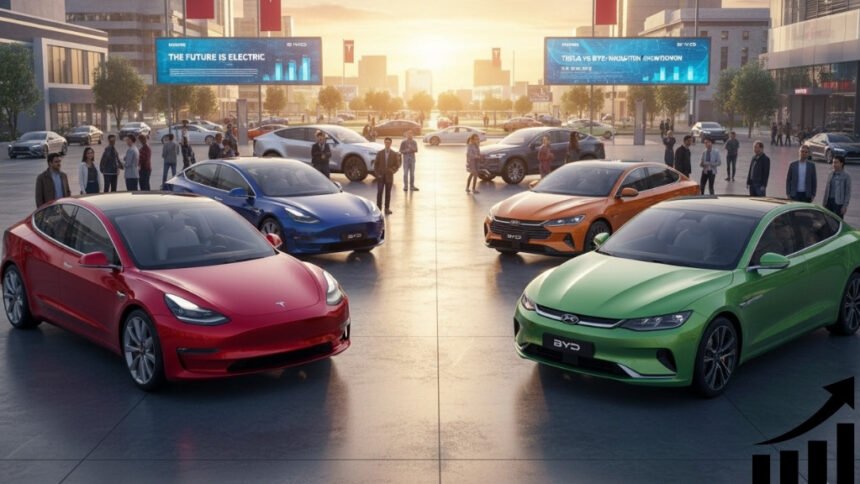
Tesla has officially lost its crown as the world’s largest electric vehicle manufacturer, marking a historic turning point in the global EV industry. China-based automaker BYD has now surged ahead, capitalizing on rapid international expansion while Tesla struggles with falling U.S. demand following the removal of federal EV tax incentives.
Tesla Sales Fall as BYD Breaks Records
Tesla reported a sharp decline in vehicle deliveries during the final quarter of 2025, recording a 16% drop compared to the same period last year. For the full year, Tesla delivered 1.64 million vehicles globally, down from nearly 1.8 million in 2024 — its first annual decline in years.
Meanwhile, BYD achieved a new milestone by delivering 2.26 million electric vehicles worldwide in 2025, reflecting an impressive 28% year-over-year growth. Much of BYD’s expansion came from strong performance across Asia, Europe, and Latin America — regions where EV demand continues to rise.
End of U.S. EV Tax Credits Reshapes Market
The biggest blow to Tesla came after the U.S. government ended EV tax credits of up to $7,500 in late 2025. These incentives had been a major driver of Tesla’s domestic success, especially since the company controls nearly 45% of the U.S. EV market.
With incentives gone, November EV sales across the U.S. plunged more than 40% year over year, signaling a wider slowdown in American EV adoption.
Tesla’s Strategy Shift Raises Concerns
Once aiming to become the world’s largest carmaker by 2030, Tesla has now shifted focus toward futuristic technologies like robotaxis, AI-powered self-driving software, and humanoid robots. While investors remain optimistic, these projects currently generate limited revenue.
The lack of new mainstream car models has also impacted Tesla’s momentum. Its popular Model Y SUV has seen minimal updates since its 2020 launch, and the much-hyped Cybertruck has struggled to gain strong sales traction.
EV Prices Drop, But Buyers Remain Cautious
To offset slowing demand, automakers have begun cutting EV prices. Tesla recently introduced a $37,000 budget Model 3, but it features reduced range and fewer interior features.
Other automakers are pushing more affordable EVs under $40,000, including:
- Chevrolet Equinox EV
- Hyundai Ioniq 5
- Nissan Leaf
However, experts believe 2026 will remain challenging, with stronger growth expected in 2027 when more affordable EV models enter the market.
Hybrid Cars Continue to Rise
While EV demand cools, hybrid vehicles are gaining popularity across the U.S. Buyers are increasingly choosing hybrids for their lower price points and reduced charging anxiety — suggesting Americans still want electrification, but with flexibility.
Wall Street Still Believes in Tesla’s Future
Despite falling car sales, Tesla’s stock remains near record highs due to strong confidence in its self-driving taxi ambitions. Tesla currently operates monitored robotaxis in Austin and San Francisco, while Google-backed Waymo already runs thousands of fully autonomous taxis across multiple U.S. cities.
What Lies Ahead for EVs in America
Industry analysts predict EVs will make up 8.5% of U.S. new car sales in 2026, rising to over 17% by 2030. Growth is expected to be strongest in states that still offer local EV incentives such as California, Colorado, and New York.